
Building a custom modern home is no longer just about the luxurious finishes or floor-to-ceiling windows; it is also about balancing long-term operational efficiency with structural performance.
While traditional construction often relies on high-energy consumption to maintain indoor comfort, Passive Houses are designed to deliver health-based standards, comfort, and sustainability through building physics and technology. By engineering an optimised building envelope, Passive House designs reduce heating and cooling energy demand by up to 90% compared to conventional builds, while establishing superior indoor air quality and precise temperature control.
Understanding the foundational principles of a Passive House shifts the focus from short-term construction trends to long-term structural integrity.
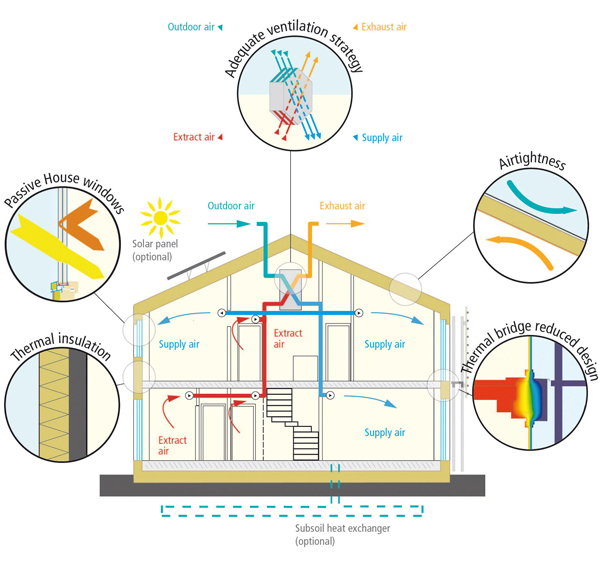
Thermal Insulation
Thermal insulation in a Passive House is a thick, continuous layer of high-performance material encasing the entire building envelope. Unlike conventional homes, where insulation is often interrupted by structural framing, the unbroken thermal layer in a Passive House maintains high thermal resistance across the house and effectively resists external weather extremes.
This ensures that your home is kept at a stable, controlled temperature year-round. By minimising the thermal expansion and contraction that typically ages a building, continuous thermal insulation also protects the underlying structure from stress, condensation, and long-term decay.
Thermal Bridge-Free Design
While continuous insulation provides the primary defence, the thermal bridge-free design of a Passive House eliminates weak spots where heat easily enters or escapes. These weak points often occur at junctions and connections such as corners, floors, and windows, allowing heat to easily bypass the main insulation layer. In standard construction, these cold spots also create prime conditions for condensation, leading to mould growth and structural decay over time.
Eliminating thermal bridges requires precision engineering. Passive home builders utilise specialised, low-conductivity insulating materials inserted directly into structural connections to create thermal breaks, isolating the building’s interior frame from exterior elements.
A thermal bridge-free design ensures your Passive Home maintains uniform surface temperatures across every interior wall, corner, and floor. This eradicates uncomfortable “cold spots” while guaranteeing a dry, durable building structure.
Airtight Construction
Small cracks around window frames, electrical outlets, and wall joints are common points of air leakage, causing energy loss, higher energy bills, and poor indoor comfort. Airtight construction creates a sealed envelope around the home, preventing uncontrolled air leakage through unsealed gaps in the building shell.
In a Passive House, a dedicated air barrier, typically made from specialised membranes, durable tapes, and liquid-applied sealants, is installed along the interior. Every single seam, wire entry, and pipe penetration is taped and sealed before interior finishes go up.
A common misconception is that an airtight house feels stuffy. However, airtightness is actually about taking control of air movement. When air leaks freely through walls, it carries moisture into the structure, which can cause hidden mould and rot. Sealing the shell keeps structural framing dry and eliminates cold drafts.
High-Performance Windows
Windows and doors are traditionally the weakest points in a home’s thermal defence. Because glass conducts heat far more easily than an insulated wall, standard single- or basic double-pane windows act as energy drains.
Passive House construction implements high-performance double- or triple-glazed windows filled with inert gas between the panes. The glass is treated with low-emissivity coatings that reflect interior heat back into the room during winter while blocking heat during summer. Furthermore, Passive House frames feature insulated cores and thermal breaks to ensure heat cannot escape around the edges.
Beyond high-performance materials, strategic window positioning is equally important to optimising indoor climate. In a Passive Home, window positioning aligns the building with the local path of the sun and prevailing breezes to capture winter warmth, block summer heat, and provide natural light and ventilation. This balances solar heat gain with high-performance insulation to keep room temperatures stable.
Heat Recovery Ventilation
A Heat Recovery Ventilation (HRV) or Mechanical Ventilation with Heat Recovery (MVHR) system serves as an atmospheric control system within a Passive House. Because an airtight structure prevents natural air leakage, continuous mechanical ventilation is required to maintain balanced pressure, control humidity, and optimise indoor air quality without thermal loss.
The system continuously extracts stale, moist air from areas such as bathrooms and kitchens, while simultaneously introducing outdoor air into living spaces. Inside the central unit, a heat exchanger allows the warm outgoing air to transfer its thermal energy to the cold incoming air, recovering a significant proportion of that warmth without the two air streams mixing. In the summer, it works in reverse to keep external heat out of the home.
Beyond reducing heating and cooling costs, the system also manages indoor air quality by passing the incoming air through high-grade filters that capture outdoor pollutants. By maintaining constant air turnover and controlling humidity, it prevents condensation and protects the house against mould growth.
Building a Passive House
Investing in a Passive House with Glen Esk Construction delivers long-term performance, sustainability, and comfort. Our certified Passive House professionals bring expertise and experience to every project, combining airtight construction, high-performance materials, and a deep understanding of building science.
Whether you are looking for a pre-designed Perth Passive House plan from The Founding Range or have a custom Passive House design in mind, our team can bring your vision to life. Contact us today to learn more.